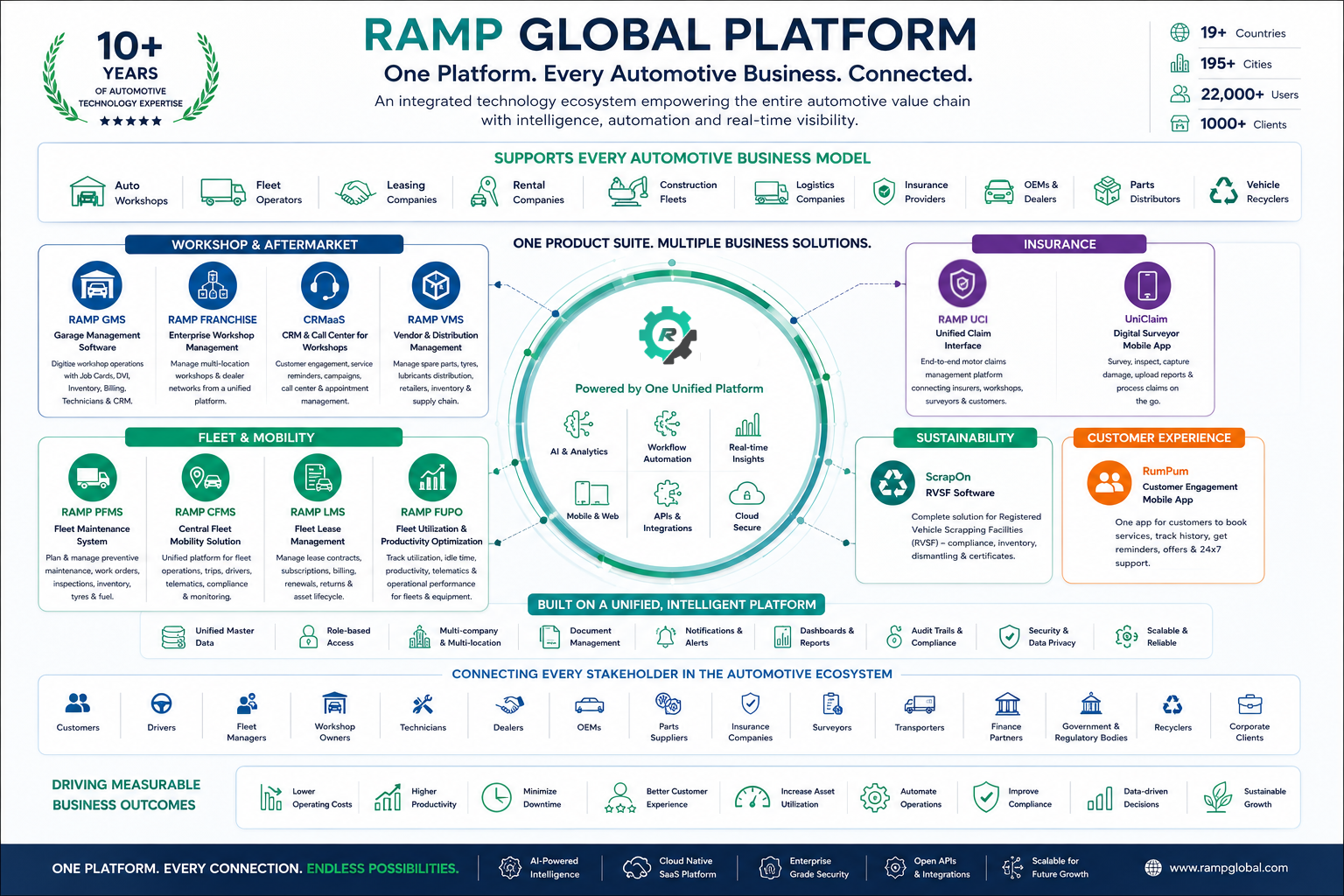
PREVENTIVE FLEET MAINTENANCE SYSTEM
From Reactive Repairs to
Preventive Fleet Control.
Plan maintenance before breakdowns happen, control service execution and costs, and keep every vehicle ready for operation.
Most Fleet Systems Record Breakdowns.
PFMS Helps You Prevent Them.
RAMP PFMS brings preventive maintenance planning, service execution, vehicle health, costs, parts and operational data together - giving fleet teams the control to maintain vehicles proactively and keep operations moving.
Prevent Unplanned Downtime
Identify upcoming maintenance and vehicle health risks before they become operational disruptions.
Control Maintenance Costs
Track maintenance spend across vehicles, workshops, parts and service activities.
Improve Vehicle Availability
Keep maintenance planned, jobs controlled and vehicles ready for operation.
Extend Asset Life
Maintain vehicles consistently with service history, preventive schedules and health visibility.
See How PFMS Turns Maintenance into Fleet Control.
Explore how RAMP PFMS helps fleet teams plan preventive maintenance, monitor vehicle health, control service execution and keep maintenance costs visible.
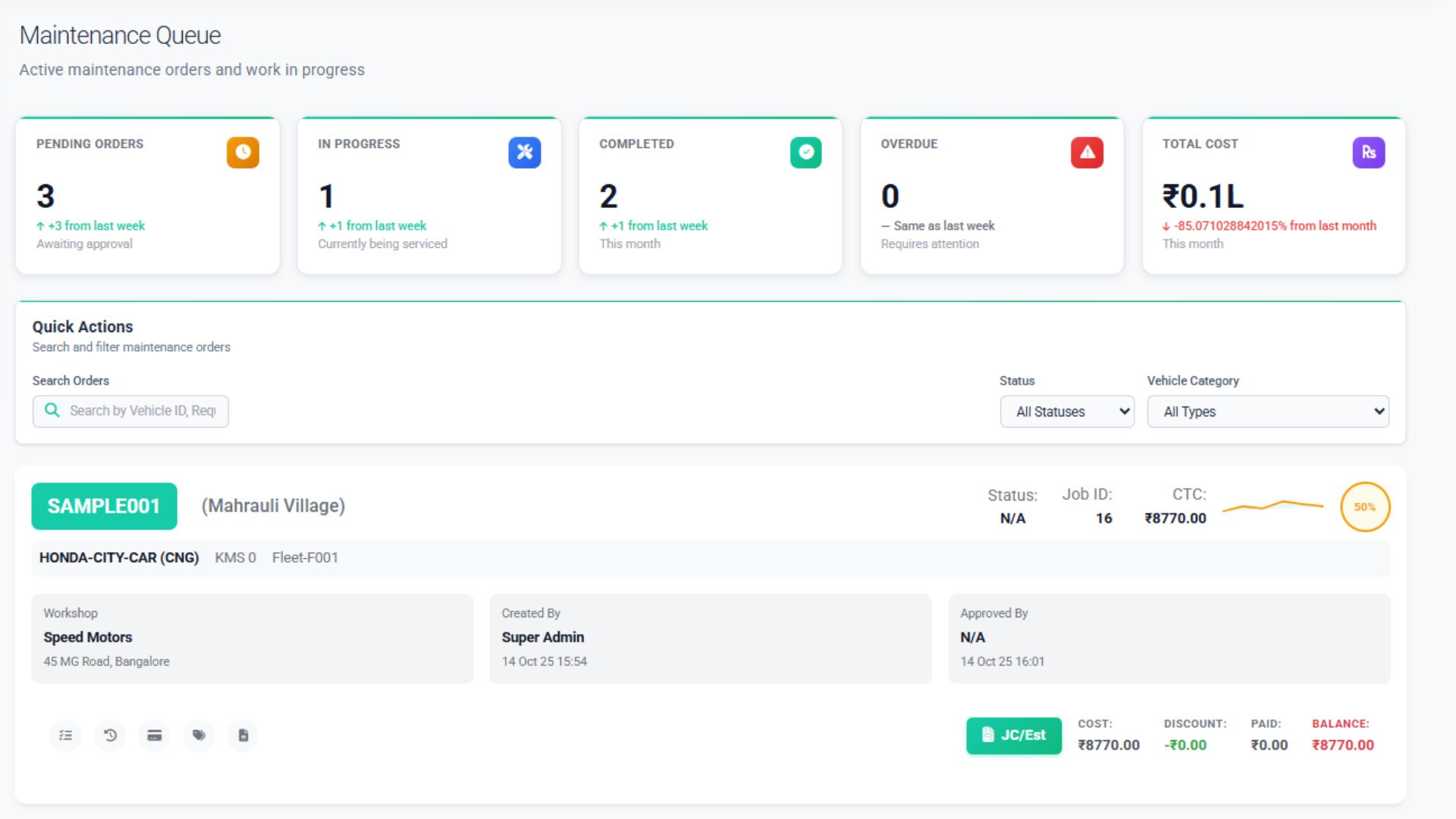
Maintenance Queue Dashboard
Real-Time Visibility into Active Service Operations▶ Browse through the screens to see a detailed look at the interface and core capabilities.
Everything You Need to Keep Your Fleet Moving
PFMS connects fleet management, maintenance, fuel, tyres, inventory, drivers, and business intelligence into one controlled fleet operation.
Know Every Vehicle. Control Every Requirement.
Manage your fleet, vehicle information, compliance documents, insurance, and operational status from one place.
Fleet & Vehicle Management
- Vehicle registration & master data
- Make, model & variant details
- Vehicle specifications
- Ownership & operational details
- Vehicle status tracking
- Vehicle-wise history
Documents & Compliance
- Fitness & permit documents
- Document expiry tracking
- Renewal alerts & notifications
- Document categories & masters
- Vehicle-wise compliance status
- Renewal history
Insurance & Vehicle Health
- Insurance policy tracking
- Insurance renewal alerts
- Insurance claim linkage
- Vehicle utilization visibility
- Vehicle performance indicators
- Vehicle health history
Plan Maintenance Before Downtime Happens.
Plan, schedule, execute, approve, and track maintenance across your fleet and workshop network.
Maintenance Planning
- Preventive maintenance schedules
- Service due tracking
- Upcoming maintenance
- Maintenance frequency
- Maintenance categorization
- Automated maintenance planning
Maintenance Execution
- Maintenance bookings
- Maintenance tickets
- Digital job cards
- Service status tracking
- Vehicle service history
- Breakdown & repair tracking
Estimates & Approvals
- Maintenance estimates
- Spare & service costing
- Approval matrix
- Approval hierarchy
- Approval status tracking
- Escalations & notifications
Control the Costs That Keep Your Fleet Running.
Track fuel and tyre operations from procurement and allocation through consumption, performance, and replacement.
Fuel & POL Management
- Fuel procurement
- Fuel reservoir management
- Fuel disbursement
- Vehicle-level fuel allocation
- Fuel consumption tracking
- Fuel expense monitoring
Fuel Intelligence
- Vehicle-wise consumption
- Fuel efficiency analysis
- Mileage tracking
- Consumption trends
- Fuel cost analysis
- High-consumption identification
Tyre Lifecycle Management
- Tyre procurement
- Vehicle & axle allocation
- Tyre inspection
- Rotation & balancing schedules
- Retreading management
- Tyre performance & replacement tracking
Keep the Resources Behind Every Vehicle Under Control.
Connect spare parts, procurement, vendors, drivers, and operational resources with fleet maintenance.
Spare Parts & Inventory
- Spare parts management
- Part number & brand mapping
- Vehicle compatibility mapping
- Spare consumption
- Parts locator
- Stock transfers & visibility
Procurement & Vendors
- Vendor management
- Spare procurement
- Purchase tracking
- Purchase cost management
- Vendor-wise analysis
- External workshop purchases
Driver & Operational Management
- Driver-vehicle assignment
- Driver documentation
- License & certification tracking
- Driver renewal alerts
- Driver performance tracking
- Internal operational expenses
Turn Fleet Data Into Better Decisions.
Bring fleet costs, maintenance performance, operational activity, approvals, and user controls into one management view.
Fleet & Maintenance Analytics
- Vehicle-wise maintenance cost
- Location-wise cost analysis
- Workshop-wise performance
- Maintenance category analysis
- Fuel & tyre cost analysis
- Repeat-maintenance identification
Business Intelligence
- Fleet & maintenance reports
- Spare & service reports
- Fuel/POL reports
- Payment & approval reports
- Business analytics
- Forecasting & trend analysis
Governance & Access Control
- Organization hierarchy
- Approval matrix
- Escalation matrix
- Role-based access
- User permissions
- User & activity logs
From Reactive Repairs to
Preventive Fleet Control.
PFMS brings structure, visibility and control to fleet maintenance - so you can reduce breakdowns, manage costs and keep every vehicle ready for operation.
Plan Maintenance Proactively
Create preventive maintenance schedules based on time, mileage or engine hours.
Control Service Execution
Manage workshop jobs, allocate technicians, track job progress and standardize service processes.
Monitor Costs & Consumption
Track maintenance costs, parts usage, labour costs and vendor performance in real time.
Maintain Vehicle Health
Get visibility into vehicle health, upcoming maintenance, service history and operational status.
Stay Compliant and Audit Ready
Track insurance, fitness, permits and other documents with renewal alerts and compliance reports.
Drive Better Operational Decisions
Use real-time reports and analytics to improve uptime, control costs and optimize fleet performance.
From Maintenance Due to Vehicle Ready.
PFMS connects the complete maintenance cycle - from identifying what needs attention to planning the work, executing the service, recording the cost and learning from the outcome.
Spot maintenance needs before they become breakdowns.
Capture scheduled service dues, inspection alerts, driver defect reports, and vehicle telematics flags into one prioritized maintenance queue.
Key Capabilities
Service Due Alerts
Track upcoming preventive maintenance milestones automatically.
Driver Inspections
Log pre-trip & post-trip defect reports and vehicle health checks.
Telematics & OBD
Detect fault codes, mileage thresholds, and high-risk health flags.
Central Intake Queue
Consolidate all maintenance signals into structured action items.
Early identification stops small issues from turning into costly disruptions.
Plan the right maintenance at the right time.
Convert upcoming maintenance requirements into planned work based on vehicle availability, workshop capacity and operational priorities.
Key Capabilities
Maintenance Planning
Generate PM schedules based on time, mileage or engine hours.
Service Scheduling
Create and manage service schedules with due dates and reminders.
Workshop Allocation
Assign jobs to internal or external workshops based on availability.
Priority Management
Set priorities and manage critical maintenance requirements.
A planned maintenance operation is easier to execute, measure and improve.
Control workshop execution from start to finish.
Standardize digital job cards, track technician tasks, approve repair estimates, and verify work quality in real time.
Key Capabilities
Digital Job Cards
Create, update, and track repair job cards digitally in real time.
Technician Tasks
Assign specific repair operations to qualified workshop technicians.
Estimate Approvals
Review parts and labour estimates before work authorization.
Quality Inspection
Validate service quality before vehicles are released back to operation.
Standardized execution ensures consistent repair quality and faster turnaround.
Keep maintenance spend, parts, and vendors under control.
Track parts consumption, verify technician labour, reconcile vendor invoices, and manage inventory across all workshops.
Key Capabilities
Parts & Inventory
Track spare parts consumption, stock levels, and procurement.
Fuel & Tyre Control
Monitor POL disbursements, tyres, and component consumption.
Vendor Invoicing
Reconcile external workshop bills against agreed rate cards.
Cost Allocation
Attribute expenses down to vehicle, location, or cost center.
Complete financial transparency prevents leakage and lowers operating costs.
Turn maintenance data into operational intelligence.
Analyze breakdown patterns, vendor performance, component life cycles, and total cost of ownership to optimize future fleet decisions.
Key Capabilities
Downtime Analytics
Identify primary causes for vehicle downtime and repeat issues.
TCO & Spend Trends
Measure cost per km and total maintenance spend by model.
Vendor Benchmarking
Evaluate workshop turnaround time, parts pricing, and quality.
Predictive PM Tuning
Refine preventive service intervals based on actual data.
Continuous learning turns routine maintenance data into long-term fleet control.
Know Where Your Fleet Maintenance Money Is Going.
Turn maintenance data into actionable insights. PFMS gives you real-time visibility into costs, trends and performance across your entire fleet - so you can control expenses and improve vehicle uptime.
Track & Control Maintenance Costs
Get complete visibility into spending across vehicles, workshops, parts and labour.
- Total cost and cost per vehicle
- Cost by maintenance type
- Parts vs labour cost
- Workshop-wise cost analysis
Analyze Maintenance Mix
Understand cost distribution across PM, breakdowns, running repairs and more.
- Maintenance type-wise analysis
- Trend over time
- High-cost components
- Compare vehicles and fleets
Identify Repeat Issues
Spot recurring failures and high-cost components to take corrective action and reduce downtime.
- Repeat repair patterns
- High-cost parts
- Vehicle-wise issue history
- Preventive action recommendations
Compare Workshop Performance
Evaluate turnaround time, cost and service quality across internal and external workshops.
- Jobs handled and completion rate
- Average TAT
- Average cost per job
- Service quality comparison
Measurable Results for a More Efficient Fleet.
Organizations using PFMS achieve better vehicle availability, lower maintenance costs and stronger operational control - leading to a more efficient and reliable fleet.
Lower Maintenance Costs
Preventive maintenance and better planning reduce unnecessary repairs and overall spend.
Reduced Downtime
Proactive maintenance and faster turnaround keep more vehicles on the road.
Higher Vehicle Availability
Better planning and monitoring ensure a higher operational fleet at all times.
Improved Resource Utilization
Optimize workshop capacity, technician productivity and parts usage.
Maintenance Compliance
Stay on top of regulatory and service due dates with timely alerts and tracking.
Stronger Fleet Performance
Turn maintenance data into insights to identify issues, control costs and improve fleet reliability.
Works Across Industries and Fleet Types.
Whether you manage commercial vehicles, construction equipment or specialized fleets, PFMS adapts to your operations and helps you maintain every asset with greater control and efficiency.
Keep Vehicles Available for Every Delivery.
When vehicles are constantly on the road, maintenance directly affects delivery schedules, operating costs and fleet availability.
- Preventive Maintenance - Plan services around mileage and operating schedules.
- Vehicle Availability - Identify vehicles due for maintenance before they impact operations.
- Workshop Control - Track jobs, turnaround time and service execution.
- Maintenance Cost - Monitor cost by vehicle, service and maintenance activity.
Key Outcomes for Logistics Fleets
Lower maintenance costs
With preventive maintenance and better planning.
Reduced vehicle downtime
Faster turnaround and higher fleet availability.
Improved fleet utilization
More vehicles on the road and higher operational efficiency.
Full financial visibility
Complete visibility into parts, labour and workshop expenses.
Keep Heavy Equipment Productive on Every Project.
Construction and project equipment face demanding operating conditions where equipment downtime can disrupt project schedules and increase operating costs.
- Equipment Maintenance - Plan service based on operating hours and maintenance schedules.
- Asset Health - Maintain equipment history and service records.
- Downtime - Track maintenance-related downtime across equipment.
- Parts & Resources - Control parts consumption and maintenance resources.
Key Outcomes for Construction & Equipment
Lower equipment downtime
Predictive service intervals avoid on-site delays.
Fewer emergency repairs
Routine wear parts replaced before critical failure.
Extended asset lifespan
Disciplined servicing protects capital asset value.
Site-Level Budgeting
Track project-level equipment expenditure accurately.
Keep Passenger Fleets Safe, Reliable and Ready.
Passenger operations depend on vehicle availability and timely maintenance to keep scheduled services running consistently.
- Service Scheduling - Plan maintenance around vehicle operating schedules.
- Vehicle Readiness - Monitor vehicles due for service or currently under maintenance.
- Maintenance History - Maintain complete service records by vehicle.
- Compliance Visibility - Track required vehicle documents and expiry dates.
Key Outcomes for Passenger Transport
Route trip readiness
Prevent trip cancellations and fleet delays.
Faster defect turnaround
Fast-track running fixes between route shifts.
Regulatory fitness
Never miss statutory permit or inspection dates.
Per-Km Cost Control
Optimize tyre, brake, and general running costs.
Bring Greater Control to Public Fleet Maintenance.
Government and municipal fleets operate across vehicles, locations and departments - making maintenance visibility and compliance essential.
- Fleet Visibility - Maintain a centralized view of vehicles and operational status.
- Compliance Tracking - Monitor fitness, permits, insurance and expiry dates.
- Maintenance Records - Maintain vehicle-wise service and repair history.
- Cost & Governance - Track maintenance expenditure and operational activity.
Key Outcomes for Government Fleets
Audit-ready traceability
Complete digital record of every work order.
Vendor leakage reduction
Transparent billing against verified parts & rates.
Standardized Service
Standard maintenance SOPs across departments.
Asset Longevity
Clear oversight from procurement to decommission.
Protect Asset Availability and Lifecycle Value.
Rental and leasing businesses depend on keeping assets available while controlling maintenance expenditure throughout the asset lifecycle.
- Preventive Maintenance - Schedule maintenance before assets become unavailable.
- Asset Health - Maintain vehicle-wise service and maintenance history.
- Maintenance Cost - Track expenditure across vehicles and maintenance activities.
- Lifecycle Visibility - Understand maintenance patterns over the asset's operating life.
Key Outcomes for Rental & Leasing
Higher rental readiness
Faster turnaround between hire contracts.
Damage chargeback proof
Digital inspection evidence resolves disputes.
Lower idle downtime
Service during gaps to preserve hire utilization.
Asset Resale Value
Verifiable maintenance history commands top price.
Keep Your Distribution Fleet Moving With Your Operations.
When vehicles support production, material movement or distribution, maintenance downtime can affect the wider operational cycle.
- Maintenance Planning - Schedule services before operational requirements are affected.
- Fleet Availability - Monitor active, maintenance and downtime vehicles.
- Workshop & Vendor Control - Track service execution and external maintenance.
- Cost Visibility - Understand maintenance spend across vehicles and services.
Key Outcomes for Manufacturing & Distribution
Reduction in repair spend
Standardized processes prevent cost inflation.
Better fleet availability
Keep operational assets ready when needed.
Digitized records
Eliminate paper job cards and manual logbooks.
Total Cost Visibility
End-to-end insights into vehicle TCO.
Empowering Every Stakeholder in Fleet Maintenance.
From fleet heads to workshop teams, PFMS gives the right information and tools to everyone involved in keeping your fleet on the road.
Fleet & Operations Head
Get complete visibility into fleet health, maintenance costs and operational performance.
- Fleet health overview
- Cost and downtime trends
- Preventive maintenance compliance
- Data-driven decision making
Maintenance Manager
Plan, track and control maintenance operations across vehicles, workshops and teams.
- Maintenance planning and scheduling
- Job tracking and TAT
- Workshop & vendor management
- Parts and cost control
Workshop Manager
Manage daily service operations, technician workload and job progress efficiently.
- Service queue management
- Job assignment and tracking
- Parts consumption tracking
- Billing and job closure
Drivers & Operators
Get timely service reminders, report issues and stay informed about vehicle status.
- Service due notifications
- Report breakdowns
- Service status updates
- Vehicle history access
Management & Finance
Track maintenance spend, control costs and measure fleet performance with accurate data.
- Cost tracking and analysis
- Budget planning
- Asset utilization insights
- Financial reporting
Questions Fleet Teams Ask Before Moving to PFMS.
Understand how RAMP PFMS fits into your existing fleet maintenance operations, teams and workflows.
What is RAMP PFMS?
RAMP PFMS (Preventive Fleet Maintenance System) is a fleet maintenance platform designed to help organizations plan preventive maintenance, manage service execution, monitor vehicle health, control maintenance costs and maintain fleet compliance from a centralized system.
How is PFMS different from a regular Fleet Management System?
While traditional operations rely on standalone Fleet GPS & Telematics or Lease Management Software (LMS), PFMS focuses specifically on the maintenance lifecycle. Connected with RAMP's Fleet Mobility Platform (CFMS), it unifies upcoming maintenance planning, workshop service execution, component costs, and vehicle uptime across commercial fleets.
Can PFMS help us move from reactive to preventive maintenance?
Yes. PFMS helps maintenance teams move from responding to breakdowns toward planned maintenance by tracking maintenance schedules, upcoming service requirements, vehicle history and maintenance activity. Teams can use this information to plan work before scheduled maintenance becomes overdue or disrupts operations.
Can PFMS manage maintenance schedules for different vehicles?
PFMS supports vehicle-wise maintenance planning and service schedules. Maintenance can be managed according to applicable service requirements such as time, mileage or engine hours, helping teams maintain different vehicles according to their operating requirements.
Can PFMS manage multiple workshops and locations?
Yes. PFMS is designed to provide centralized visibility across fleet operations, locations and maintenance activities. Organizations can monitor maintenance requirements, service activity, vehicle status and related operational information across their fleet.
Can PFMS track maintenance costs?
Yes. PFMS provides visibility into maintenance expenditure across vehicles and maintenance activities, helping teams understand parts, labour, workshop and other maintenance-related costs and identify where maintenance spending is increasing.
Can PFMS manage fleet compliance and document renewals?
Yes. The Fleet & Compliance capabilities help organizations manage vehicle documents and track requirements such as fitness, permits, insurance and expiry dates, with renewal alerts and compliance visibility to help teams stay on top of upcoming requirements.
Can PFMS support different types of fleets and industries?
Yes. PFMS can be applied across different fleet environments, including logistics and transportation, construction and equipment operations, passenger transport, government and municipal fleets, rental and leasing, and manufacturing and distribution. The maintenance workflow can be adapted to the operational requirements of each fleet.
Still have questions about PFMS?
Talk to Our Team →Maximize Your Fleet Uptime
Transition from reactive repairs to predictive maintenance. RAMP PFMS ensures your fleet stays on the road and profitable.
Start optimizing your fleet today
Keep Moving. Stay Profitable.