AUTOMOTIVE PARTS & AFTERMARKET
Connect the Aftermarket.
Understand What Moves Through It.
Bring manufacturers, distributors, retailers, workshops and fleet networks into one connected operating ecosystem - from catalog specification and supply to installation, service and consumption insights.
Parts & Components
Lubricants & Fluids
Tyres & Batteries
Distribution & Supply Chain
Workshops & Retail Trade
Consumption Intelligence
The Aftermarket Is Bigger Than the Sale.
A product may pass through several businesses before it reaches the vehicle. Manufacturers, distributors, retailers, workshops, fleets and service networks all influence where products move, how they are used and what demand looks like.
Distributed Channels
Products move through manufacturers, distributors, dealers, retailers and service networks.
Regional Demand
Demand, availability and product movement vary across markets and vehicle populations.
Multiple Routes to Market
Products reach customers through distribution, retail, workshops, service networks or fleets.
Service-Driven Demand
Maintenance and repair activity directly influences demand for parts, lubricants, tyres, batteries and consumables.
Limited Downstream Visibility
Organizations know what entered a channel without fully seeing what happens further downstream.
Consumption Matters
The most useful market signal is what is actually installed, used or consumed on the vehicle.
One Aftermarket.
Many Businesses and Channels.
Automotive aftermarket operations connect diverse market participants around genuine catalog data, product availability, service execution and vehicle maintenance demand.
Multi-Stakeholder Aftermarket Flow
MANUFACTURERS & BRANDS
Produce and supply authentic parts and lubricants
DISTRIBUTORS
Stock and distribute across regions
RETAILERS / DEALERS
Make products available in local markets
WORKSHOPS & SERVICE NETWORKS
Install products and deliver vehicle services
FLEETS
Service and maintain multiple vehicles
VEHICLE OWNERS
Purchase, service and maintain their vehicles

CONNECTED ECOSYSTEM PARTICIPANTS
Insurers
Claim support, total-loss vehicles and replacement parts demand
Recyclers & Recovery Networks
End-of-life vehicles, parts recovery and material recycling
From Product Definition to Vehicle Consumption -
Connected End to End.
Define
Product catalog, specification, SKU mapping and positioning.
Distribute
Move products through regional distributors and authorized channels.
Make Available
Ensure products reach retailers, service points and workshops.
Order
Workshop and customer demand converts into purchase requirements.
Fulfil
Products move from supply points to the local point of service.
Install / Service
Products become part of a repair, maintenance or service activity.
Consume
The part or fluid is installed, used or consumed by the vehicle.
Learn & Predict
Distribution and consumption telemetry reveal future demand patterns.
Different Routes to Market. Different Operating Models.
Recognizing that aftermarket participants operate diverse go-to-market strategies, operational requirements vary across distribution architectures.
Manufacturer-Led Distribution
Brands managing distribution through authorized or regional distributor channels.
Distributor-Led Network
Multi-brand distributors managing stock availability across regional retail and garage accounts.
Service-Driven Distribution
Lubricant, parts or consumable brands whose demand is strongly connected to service activity.
Multi-Partner Aftermarket
Organizations managing multiple downstream channels across workshops, fleets and regional retailers.
Growth Creates More Channels, More Partners and More Data.
As product lines expand and distribution footprints scale across geographies, operational visibility across multiple handoffs becomes critical.
Channel Visibility
Understanding product movement across distributors, retailers, workshops and fleet networks.
Product Availability
Knowing where products are stocked in real time and where regional supply gaps exist.
Partner Coordination
Managing multiple independent organizations participating in distribution and service.
Demand Understanding
Connecting regional vehicle population data with active service-driven demand.
Consumption Visibility
Understanding what products and fluids are actually installed or consumed on vehicles.
Network Growth
Expanding distribution footprint and service reach without losing operational visibility.
Where Digital Connectivity Changes the Aftermarket Operation.
Addressing real aftermarket business situations across distributor visibility, garage demand, inventory coordination, and consumption telemetry.
Distributor & Channel Visibility
Connect activity and orders seamlessly across multi-tier distributors and downstream retail channels.
Product Availability
Bring demand and supply information closer together to eliminate stock-outs and improve fulfillment.
Workshop-Driven Demand
Connect service bay repair requirements directly with catalog specifications and parts fulfillment.
Lubricant & Consumable Consumption
Trace product movement from bulk distribution through service bays and actual vehicle consumption.
Parts & Supplier Operations
Coordinate supplier requirements, purchase orders, regional inventory and counter sales.
Aftermarket Demand Intelligence
Synthesize distribution, service and consumption data into actionable regional demand telemetry.
Connect the Operations Behind the Aftermarket.
Digital capabilities engineered to unite catalog governance, distribution visibility, order routing, workshop consumption, and network-wide aftermarket intelligence.
Product & Catalog
Maintain relevant product, SKU, pricing and catalog information across the network.
Distribution & Supply
Connect suppliers, distributors, inventory availability and regional supply activity.
Orders & Fulfilment
Connect product demand with ordering, allocation, routing and fulfilment workflows.
Service & Consumption
Connect workshop, fleet and service activity with product requirements and downstream installation.
Demand & Market Telemetry
Understand regional replacement rates, fast-moving items, and service-driven demand patterns.
Network Intelligence
Bring distribution, service, demand and consumption information together for a unified aftermarket view.
The Capabilities Behind a
Connected Aftermarket Operation.
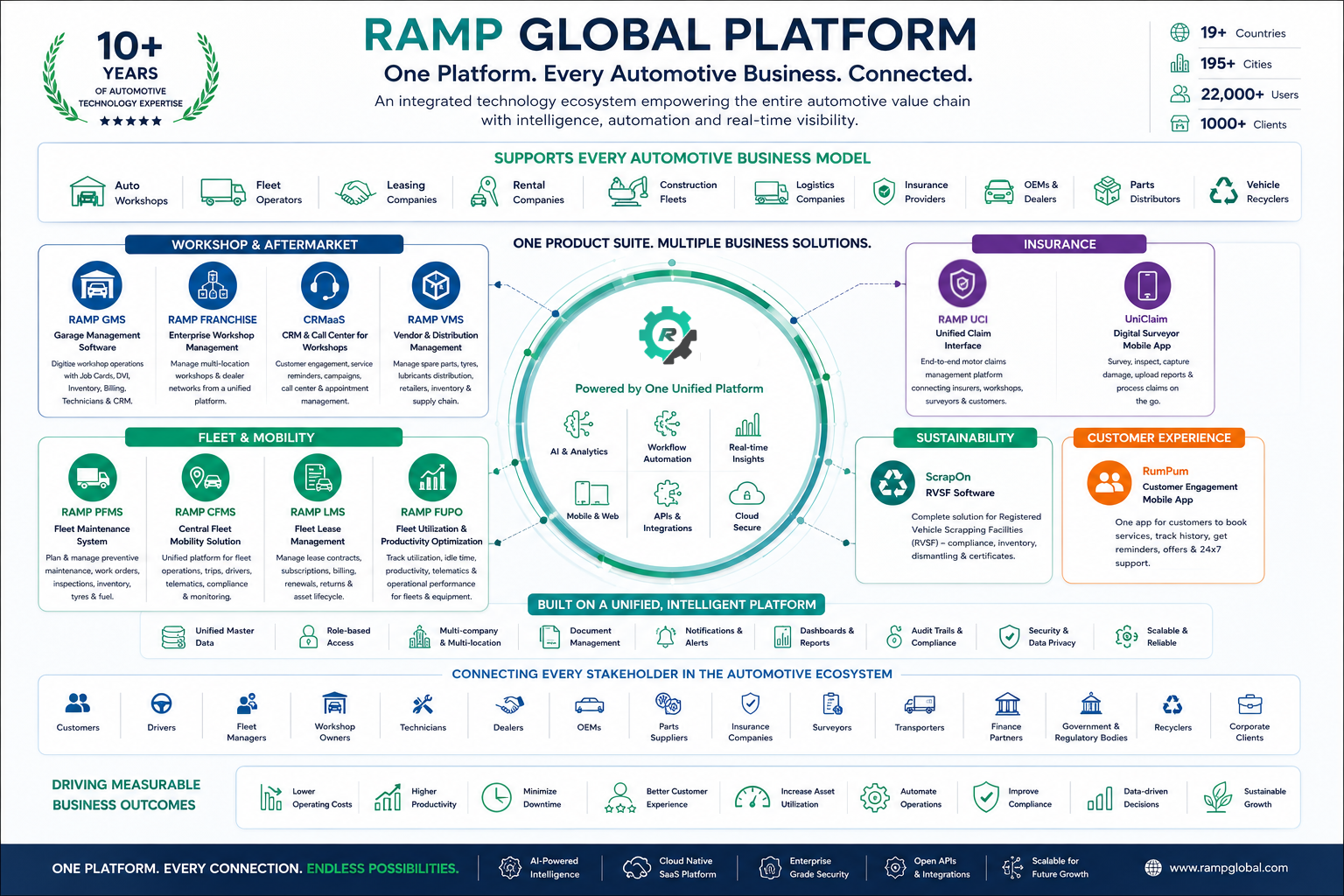
Combine specialized RAMP products and enterprise solutions into a unified aftermarket architecture spanning parts supply, workshop management, fleet maintenance, warranty claims, and end-of-life recovery.
VMS
Parts & Supplier
Operations
WMS / GMS
Workshop Execution
& Service Operations
PFMS
Fleet Maintenance
& Parts Consumption
AUTOMOTIVE PARTS
& AFTERMARKET
Connect distribution, service, vehicle operations and downstream consumption.
A More Connected View of the Aftermarket.
Transforming fragmented channel operations into transparent, connected, and data-informed aftermarket distribution.
Distribution Visibility
Understand product movement across channels and regions.
Product Availability
Improve visibility into where products are available and where demand exists.
Partner Performance
Understand activity across distributors, retailers and service partners.
Demand Intelligence
Connect market, service and distribution signals.
Consumption Visibility
Gain a clearer view of downstream product usage where data is available.
Network Growth
Expand channels and service reach with greater operational visibility.
Everything You Need to Know
About Automotive Parts & Aftermarket
Explore common questions regarding the connected automotive parts ecosystem, multi-tier distribution, and demand synchronization with RAMP.
01. What types of automotive aftermarket businesses can use RAMP?
RAMP is designed for organizations involved in the automotive aftermarket, including parts and component manufacturers, lubricant and fluid brands, distributors, suppliers, retailers, workshop and service networks, fleet businesses and other organizations operating across multiple aftermarket channels. The relevant RAMP capabilities can be used according to the organization's business model, distribution structure and service ecosystem.
02. Can RAMP support different automotive aftermarket business models?
Yes. RAMP can support different aftermarket operating models, including manufacturer-led distribution, distributor-led networks, service-driven distribution and multi-partner aftermarket networks. The platform can connect the relevant organizations, workflows and data across the model rather than requiring every business to operate in the same way.
03. Can RAMP support products beyond automotive spare parts?
Yes. The aftermarket can include different product categories such as automotive parts, lubricants, fluids, tyres, batteries and other consumables. RAMP's applicability depends on the specific product, channel and workflow being managed. The platform can connect relevant product, distribution, service and downstream activities rather than limiting the ecosystem to traditional spare parts.
04. Can RAMP connect manufacturers, distributors, retailers and workshops?
Yes. RAMP can connect relevant participants across the aftermarket network, including manufacturers or brands, distributors, retailers/dealers and workshops or service networks. Depending on the operating model, this can provide connected visibility across product distribution, demand, ordering, fulfilment and service-related activity.
05. Can RAMP connect product demand with workshop or service activity?
Yes. RAMP can connect product requirements with relevant workshop, fleet or service activity. For example, a maintenance or repair requirement can create a product requirement, which can then be connected with ordering, fulfilment and downstream service activity where the relevant workflows are implemented. This helps organizations understand the relationship between service activity and product demand.
06. Can RAMP provide visibility into downstream product consumption?
RAMP can provide downstream visibility where the relevant order, service, installation or consumption data is captured within the connected workflows or available through integrations. This allows organizations to connect upstream distribution information with downstream service and consumption signals, helping them understand where products are being used and where demand is developing.
07. Can an organization start with one product, region or channel and expand later?
Yes. An organization can introduce relevant RAMP capabilities around a defined business requirement and expand the connected operating model as additional products, regions, channels or partners are brought into scope.